OLAP - Strategic Financial Health & Efficiency
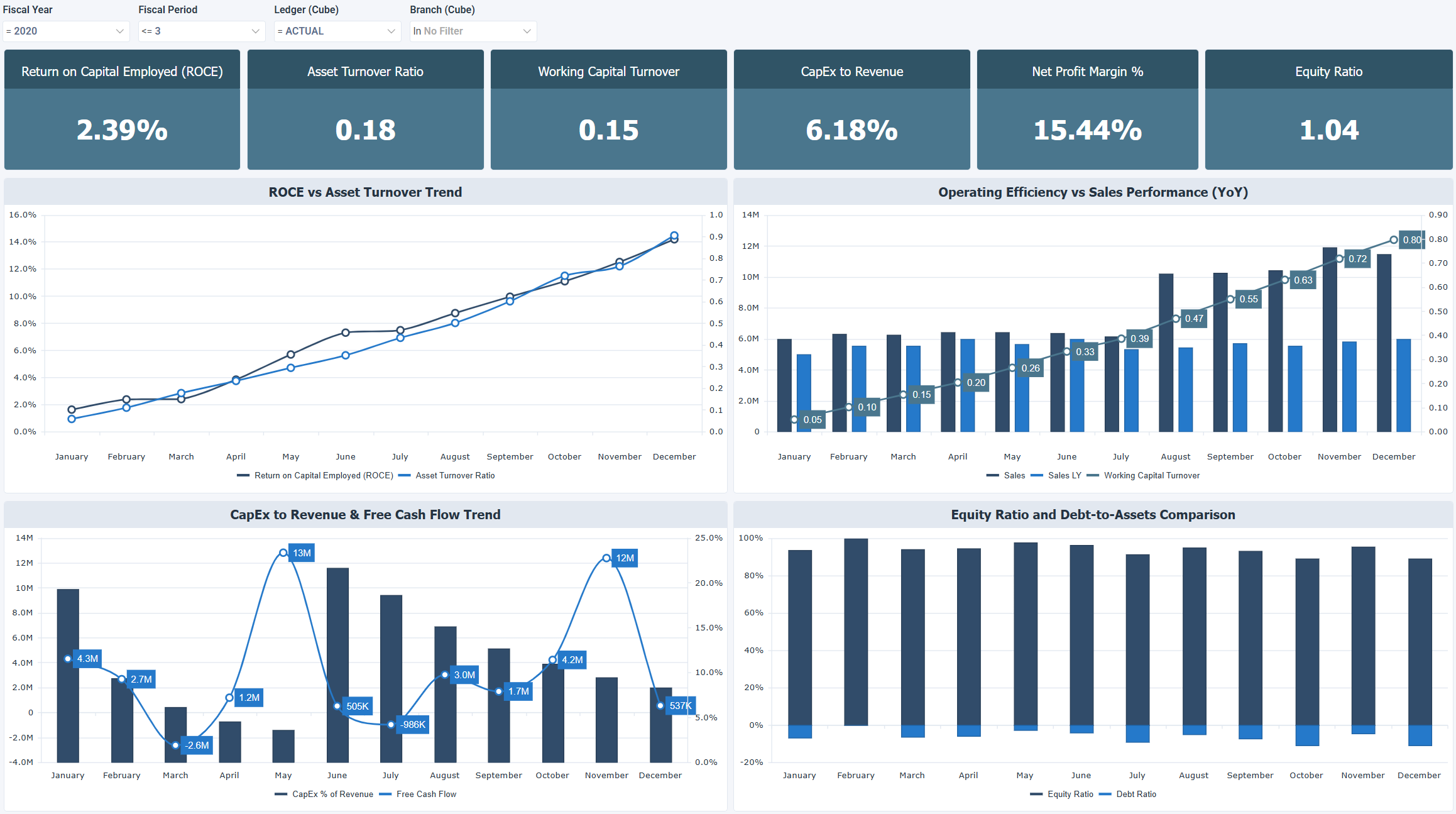
The OLAP - Strategic Financial Health & Efficiency dashboard provides an executive view of capital efficiency, profitability, asset utilization, and balance sheet structure. It helps senior leaders assess how effectively the organization converts invested capital into profits, how efficiently it uses assets and working capital to generate sales, and how sustainable its financial structure is over time.
Benefits of this dashboard
- Evaluate capital efficiency: Helps executives assess whether invested capital is generating adequate operating returns.
- Monitor operational asset productivity: Measures how effectively assets and working capital drive revenue growth.
- Analyze profitability sustainability: Provides visibility into net‑margin strength to guide pricing, cost structure, and investment decisions.
- Oversee capital intensity and reinvestment: Supports leadership in balancing growth investments with revenue generation capacity.
- Assess financial structure and solvency: Strengthens governance by tracking the balance between equity financing and leverage exposure.
Key performance indicators
| KPI | Description |
|---|---|
| Return on Capital Employed (ROCE) | Efficiency of generating operating profit from total capital employed. Higher values indicate stronger capital productivity and value creation, while lower values indicate underutilized invested capital or weaker operating returns. |
| Asset Turnover Ratio | Revenue generated per unit of total assets. Higher values indicate stronger asset utilization and operating efficiency, while lower values indicate a larger asset base relative to revenue. |
| Working Capital Turnover | Sales generated per unit of working capital. Higher values indicate efficient liquidity use and faster operating cycles, while lower values indicate more capital tied up in short-term assets. |
| CapEx to Revenue | Capital expenditures as a percentage of revenue. Higher values indicate heavier reinvestment in fixed assets and growth infrastructure, while lower values indicate lighter capital intensity or constrained reinvestment. |
| Net Profit Margin % | Net income as a percentage of total revenue. Higher values indicate stronger overall profitability and cost control, while lower values indicate margin compression and weaker earnings conversion. |
| Equity Ratio | Proportion of total assets financed by shareholders' equity. Higher values indicate stronger financial independence and lower leverage risk, while lower values indicate greater reliance on debt financing. |
Example dashboard
Filters
Use the filtering panel at the top of the dashboard to control which data is shown. The filters apply to all views and ensure the dashboard reflects the selections you choose.
- Fiscal Year
- Fiscal Period
- Ledger (Cube)
- Branch (Cube)