Journal Entry
The Journal Entry Writeback template creates balanced general ledger journal entries in Sage Intacct directly from a workbook. Use it for month-end adjustments, accruals, reclassifications, intercompany entries, and other manual GL transactions with multiple debit and credit lines. It uses the NECWRITEBACK formula, generated with the Writeback Wizard, to send changes from your workbook back to Sage Intacct.
Typical workflow
- Complete the journal entry header.
- Enter the debit and credit lines in the transaction grid.
- Review the Validation column and correct any line-level errors.
- Review in the Batch Check table on the right that total debits equal total credits.
- Confirm the status is OK – Balanced.
- Select Push to Intacct to create the journal entry.
- After a successful writeback, use the populated Batch Number field in the header to open the entry in Sage Intacct.
- Select Reset before preparing another journal entry.
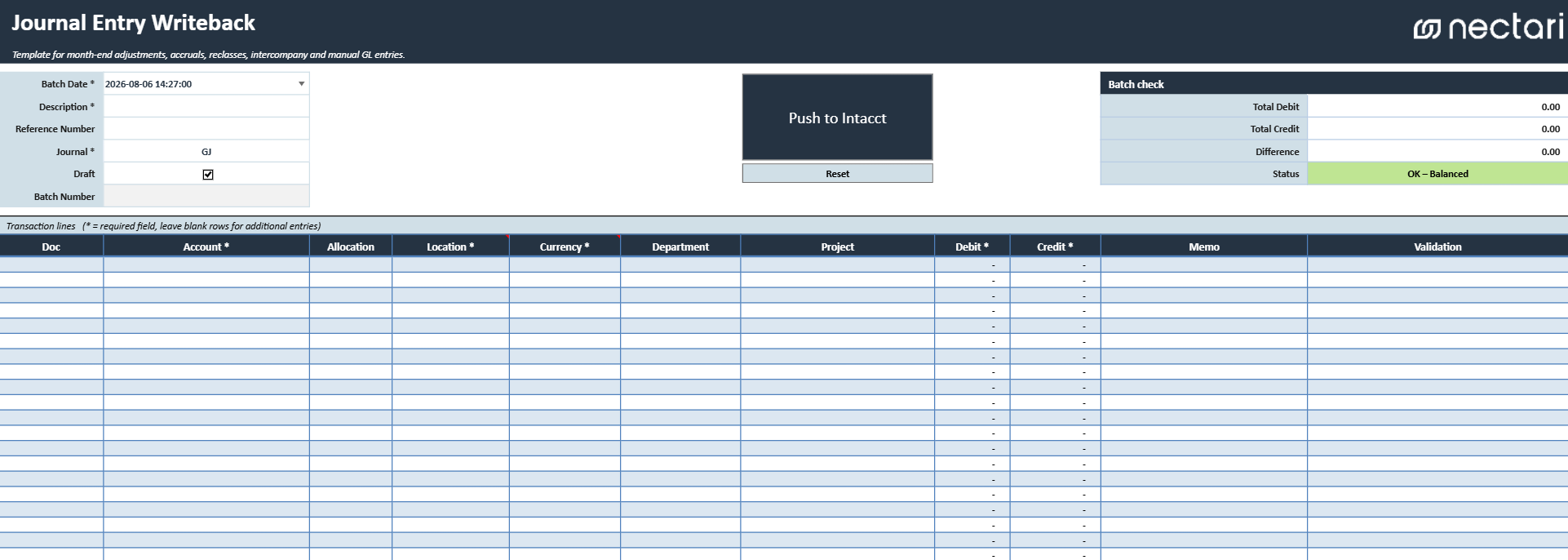
Entry header
Contains information shared by every transaction line in the journal entry.
| Entry field | What it does |
|---|---|
| Batch Date | Date assigned to the journal entry. |
| Description | Brief description of the purpose of the journal entry. |
| Reference Number | Reference number of the transaction. |
| Journal | Journal to which the journal entry will be written. |
| Draft | State in which the journal entry will be created. Unchecking this box will create a posted transaction. |
| Batch Number | Batch number returned by Sage Intacct after a successful writeback. The populated value links to the created entry. |
Writeback actions
| Writeback action | What it does |
|---|---|
| Push to Intacct | Validates the completed template and creates the journal entry in Sage Intacct. A confirmation message indicates whether the writeback succeeded. |
| Reset | Clears the current journal entry so the template can be used for another entry. Use this only after the current entry has been successfully written back or is no longer needed. |
Transaction grid
Contains the individual debit and credit lines that make up the journal entry. For each line, enter either a debit or a credit, not both.
| Transaction grid column | What it shows |
|---|---|
| Doc | Document number of the journal entry. |
| Account * | General ledger account to debit or credit. |
| Allocation | Allocation ID used to distribute the transaction amount across multiple dimensions or accounts. |
| Location * | Location associated with the transaction line. |
| Currency * | Transaction currency for the journal entry. |
| Department | Department associated with the transaction line, when applicable. |
| Project | Project associated with the transaction, when applicable. |
| Debit * | Debit amount for the transaction line. Leave blank when entering a credit. |
| Credit * | Credit amount for the transaction line. Leave blank when entering a debit. |
| Memo | Description or memo for the individual transaction line. |
| Validation | Displays missing field errors, invalid combinations, or confirmation that the line is ready. |
Fields marked with an asterisk (*) are required on each populated line. Location and Currency are only required if multi-currency is enabled in Sage Intacct.
Review the entry before writeback
- Confirm that all required (*) fields are complete on every populated line.
- Resolve any errors shown in the Validation column.
- Check the Batch Check table to confirm Total Debit equals Total Credit and the difference is zero.
- Confirm the Status shows the entry is balanced and ready for writeback.
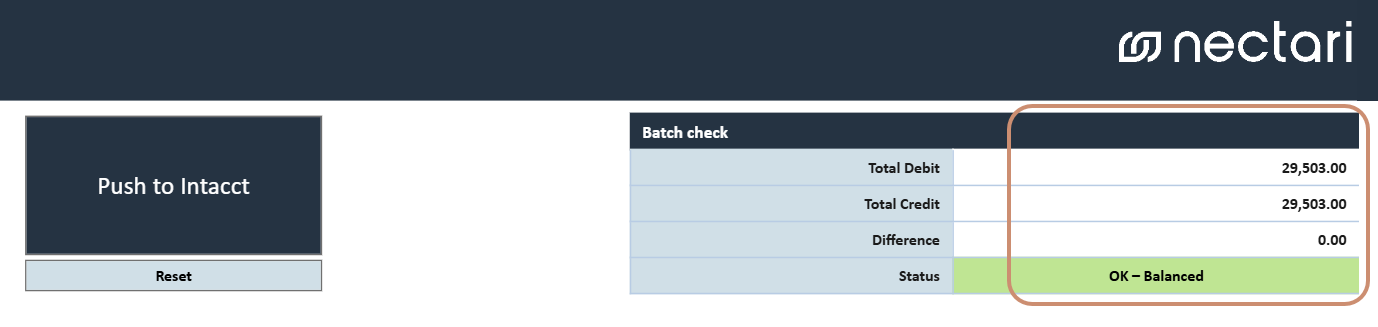
The entry can be written back only when all required fields are complete, no line-level errors remain, and the debit and credit totals are equal. Writing the entry back to Sage Intacct and releasing it are separate actions. The entry is released from Sage Intacct once it's ready.