Forecast Revision / Rolling Forecast
The Forecast Revision / Rolling Forecast Writeback template creates a new forecast budget in Sage Intacct using actual results for completed periods and an existing budget as the baseline for the remaining periods. Use it for quarterly reforecasts, monthly rolling forecasts, and other forecast revisions made during the year. Each revision is created as a new budget using a new Target Forecast Budget ID. The existing baseline budget is not updated.
The template uses the NECWRITEBACK formula, generated with the Writeback Wizard, to send the completed forecast to Sage Intacct.
Select Initialize before editing forecast amounts. Initialization creates a separate workbook copy with static extracted data so your entries are not lost if the workbook is refreshed.
Typical workflow
- Enter a unique Target Forecast Budget ID and optional forecast description.
- Select the Starting Reporting Period for the 12-period forecast window.
- Select the Baseline Budget ID used to populate the remaining forecast periods.
- Select the actuals Book and Actuals Through Period. The selected cutoff period is included in actuals.
- Use the available filters to limit the accounts and dimensions included in the forecast.
- Review the resulting 12-period window and confirm that the actual and forecast periods are correct.
- Select Initialize to create a working copy of the workbook with static extracted data.
- Use the forecast helper columns to generate amounts for the remaining periods, or enter and adjust forecast amounts manually.
- Review the combined actual and forecast totals.
- Select Push to Intacct to create the new forecast budget in Sage Intacct.
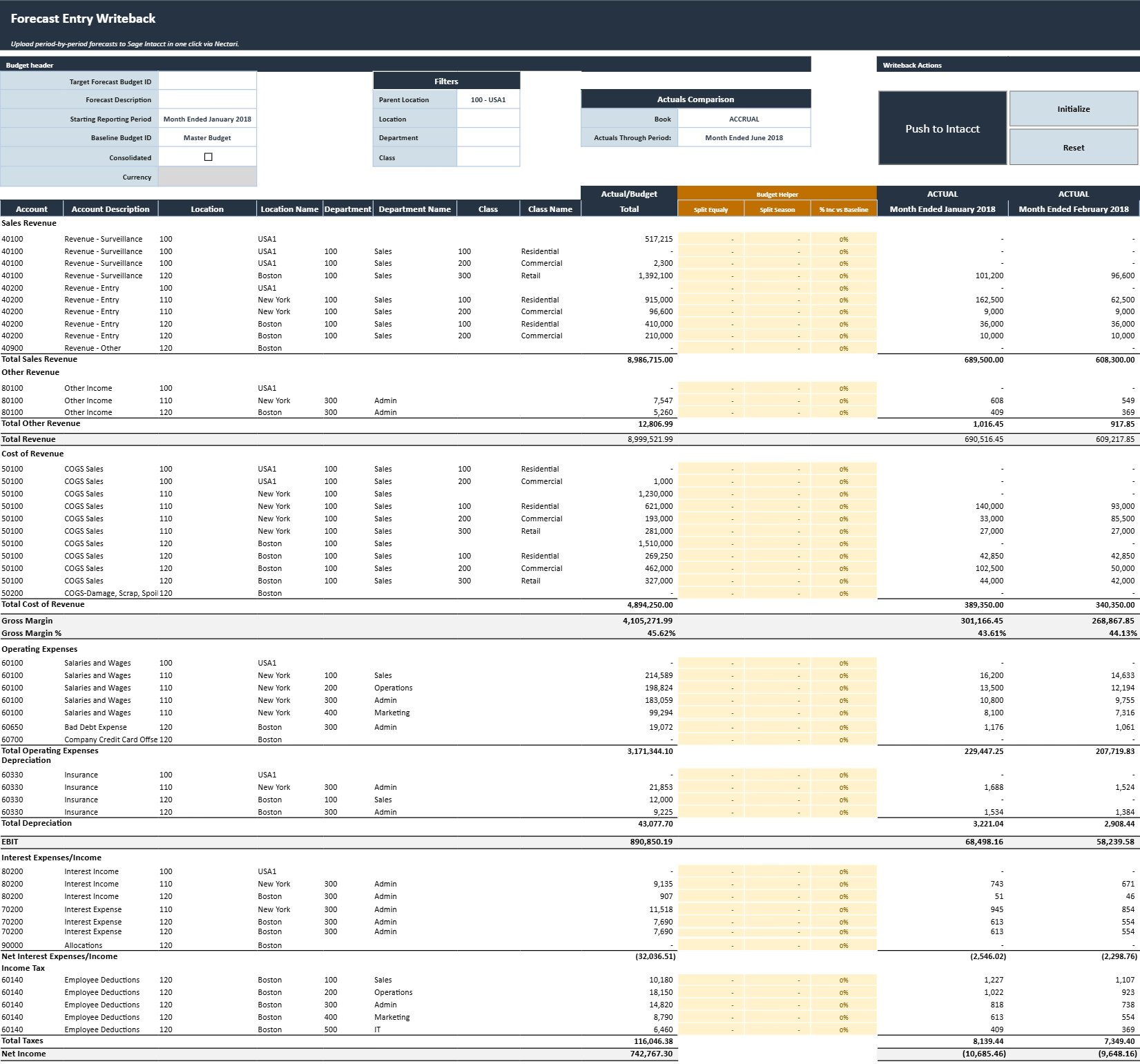
Forecast header
Defines the new forecast budget, the 12-period reporting window, and the baseline budget used for future periods.
| Forecast field | What it does |
|---|---|
| Target Forecast Budget ID | Unique identifier for the new forecast budget to create in Sage Intacct. Use a new ID for each forecast revision. |
| Forecast Description | Description used to identify the forecast version or revision. |
| Starting Reporting Period | First fiscal period in the 12-period forecast window. |
| Baseline Budget ID | Existing budget used as the starting point for periods after the actuals cutoff. |
| Consolidated | Indicates whether the forecast budget is consolidated. |
| Currency | Currency for the forecast budget. Required when creating a consolidated budget. |
Forecast filters
Filters determine which accounts and dimension combinations are loaded into the forecast grid, and can be combined to narrow the forecast to a specific organizational scope.
- Parent Location: Limits the forecast to locations belonging to the selected parent location.
- Location: Restricts the forecast to the selected location.
- Department: Narrows the forecast to the selected department.
- Class: Filters the forecast down to the selected class.
Actuals comparison
Defines which actual results are included in the working forecast. The working workbook therefore combines actual results through the cutoff period with forecast amounts for the remaining periods.
- Book: Sage Intacct book from which actual results are retrieved.
- Actuals Through Period: Last fiscal period treated as actual. The selected period is included in the actual portion of the forecast; subsequent periods use the baseline budget as their starting point.
Writeback actions
| Writeback action | What it does |
|---|---|
| Push to Intacct | Creates the new forecast budget in Sage Intacct using the selected Target Forecast Budget ID. Periods through the actuals cutoff are written as zero-valued budget entries, while subsequent periods receive the forecast amounts. |
| Initialize | Creates a separate workbook copy with (Initialized) added to the workbook name. Data extractions are disabled and the extracted data is made static so it remains unchanged while the forecast is being prepared. |
| Reset | Clears the current changes and restores the workbook to its last saved state. Any unsaved forecast entries or edits are removed. |
Forecast grid
The forecast grid displays the selected accounts and dimensions, actual results through the cutoff period, forecast periods after the cutoff, and helper columns for preparing the remaining forecast. Actual periods should remain unchanged while preparing the forecast, only the remaining forecast periods are meant to be revised.
| Forecast grid column | What it shows |
|---|---|
| Account | General ledger account included in the forecast. |
| Account Description | Description of the general ledger account. |
| Location | Location associated with the forecast line. |
| Location Name | Description of the location. |
| Department | Department associated with the forecast line. |
| Department Name | Description of the department. |
| Class | Class associated with the forecast line. |
| Class Name | Description of the class. |
| Actuals/Budget Total | Combined working total based on actual periods through the cutoff and forecast amounts for the remaining periods. |
| Actual periods | Actual general ledger amounts through and including the selected cutoff period. |
| Forecast periods | Forecast amounts for periods after the cutoff. These initially use the selected baseline budget and can be adjusted using helpers or manual entry. |
| Total | Combined total of the actual and forecast periods for the line. |
Forecast helper columns
The helper columns provide different methods for adjusting the remaining forecast periods, affecting only periods after the selected actuals cutoff. Use one helper at a time for each line, since generated values can also be overridden with manual entries or Excel formulas.
If more than one helper column contains a value on the same line, only one is applied. Split Equally takes priority over Split Season, and Split Season takes priority over % Inc Baseline. Any value entered in a helper further down that order is ignored while a helper with more priority also has a value.
- Split Equally distributes the entered total for the remaining periods evenly across all forecast periods after the cutoff.
- Split Season distributes the entered total for the remaining periods using the proportions of the corresponding baseline budget periods. If the remaining baseline total is zero, use Split Equally or enter the amounts manually.
- % Inc Baseline applies the entered percentage increase or decrease to the baseline budget values for each remaining forecast period. Entering 0% leaves the baseline values unchanged.
Review the forecast before writeback
- Confirm the Target Forecast Budget ID is new and identifies the intended forecast revision.
- Verify the Starting Reporting Period, Baseline Budget ID, Book, and Actuals Through Period are correct.
- Check that the selected filters produced the intended accounts and dimension combinations.
- Make sure the 12-period window and actuals cutoff are correct.
- Leave completed actual periods unchanged.
- Review all remaining forecast amounts, including values generated by helper columns or entered manually.
- Review the combined actual and forecast totals for each line.
- Confirm that the workbook has been initialized before entering or changing forecast amounts.
- Select Push to Intacct when the forecast is ready.
The forecast budget stored in Sage Intacct contains zero-valued entries through the actuals cutoff and forecast amounts for the remaining periods. For a full-period outlook, reporting should combine actual results through the cutoff with this forecast budget for subsequent periods. Each revision creates a new forecast budget. To prepare another revision, use a new Target Forecast Budget ID rather than updating the previous forecast in place.