Annual Budget
The Annual Budget Writeback template creates general ledger budgets in Sage Intacct directly from a workbook. Use it to prepare annual budgets by account, location, department, and class using prior-year actuals as a starting point.
Monthly budget amounts can be generated using the built-in calculation helpers or entered and adjusted manually. The template uses the NECWRITEBACK formula, generated with the Writeback Wizard, to send the completed budget to Sage Intacct.
Select Initialize before editing budget amounts. Initialization creates a separate workbook copy with static extracted data so your entries are not lost if the workbook is refreshed.
Typical workflow
- Enter a unique Budget ID and optional description.
- Select the Starting Reporting Period. This determines the 12 fiscal periods included in the new budget.
- Select the actuals Book and review the automatically generated Reference Range used for comparison.
- Use the available filters to limit the accounts and dimensions included in the budget.
- Select Initialize to create a working copy of the workbook with static extracted data.
- Use the budget helper columns to generate monthly amounts, or enter and adjust budget amounts manually.
- Review the monthly reporting periods and override any period header from its dropdown if needed.
- Review the monthly amounts and totals.
- Select Push to Intacct to create the budget in Sage Intacct.
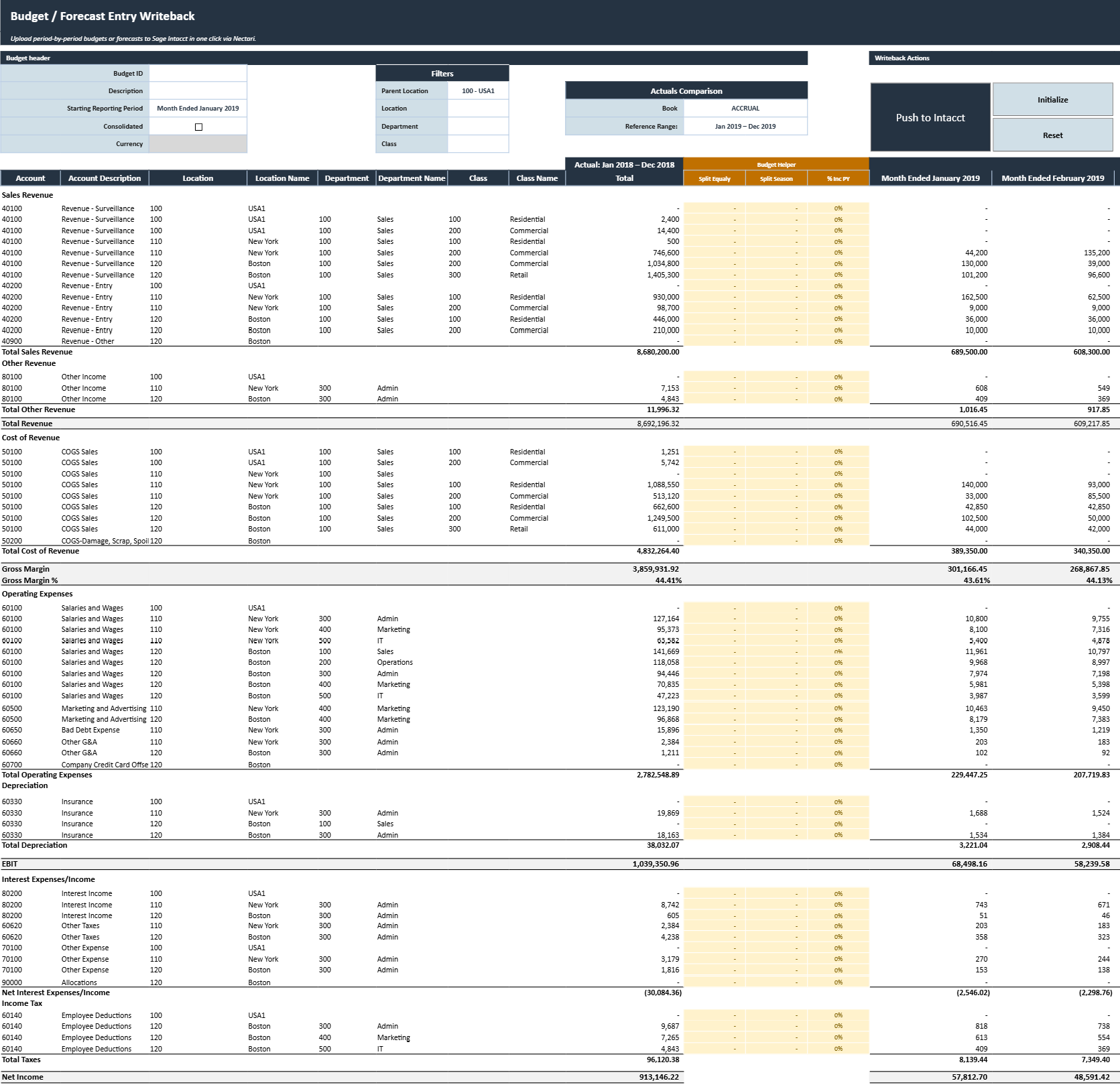
Budget header
Identifies the budget to create and determines the fiscal periods included in the budget.
| Budget field | What it does |
|---|---|
| Budget ID | Unique identifier for the new budget in Sage Intacct. |
| Description | Description used to identify the purpose or scope of the budget. |
| Starting Reporting Period | First fiscal period of the budget. The following 11 periods are generated automatically. |
| Consolidated | Indicates whether the budget is a consolidated budget. |
| Currency | Currency for the budget. Required when creating a consolidated budget. |
Monthly reporting period headers are generated automatically from the selected Starting Reporting Period. If a generated period doesn't match the intended budget period, its dropdown can be used to select the correct one manually.
Budget filters
Filters determine which accounts and dimension combinations load into the budget grid, and can be combined to narrow the budget to a specific organizational scope, such as a single department within one location.
- Parent Location: Limits the budget to locations belonging to the selected parent location.
- Location: Restricts the budget to the selected location.
- Department: Narrows the budget to the selected department.
- Class: Filters the budget down to the selected class.
Actual comparison
Defines the historical actuals displayed alongside the new budget.
- Book: Sage Intacct book from which the comparison actuals are retrieved.
- Reference Range: Fiscal periods used for the actual comparison. The range is determined automatically from the selected Starting Reporting Period and normally covers the corresponding 12 periods one year earlier.
Writeback actions
| Writeback action | What it does |
|---|---|
| Push to Intacct | Writes the prepared monthly budget amounts to Sage Intacct. A confirmation message indicates whether processing completed successfully. |
| Initialize | Creates a separate workbook copy with (Initialized) added to the workbook name. Data extractions are disabled and the extracted data is made static so it remains unchanged while the budget is being prepared. |
| Reset | Clears the current changes and restores the template to its last saved state. Any unsaved budget entries or edits are removed. |
Budget grid
The budget grid shows the selected accounts and dimensions alongside reference-period actuals, calculation helpers, and the monthly budget amounts being prepared. Since the 12 budget periods come from the selected Starting Reporting Period, they don't need to align with a calendar year.
| Budget grid column | What it shows |
|---|---|
| Account | General ledger account included in the budget. |
| Account Description | Description of the general ledger account. |
| Location | Location associated with the budget line. |
| Location Name | Description of the location. |
| Department | Department associated with the budget line. |
| Department Name | Description of the department. |
| Class | Class associated with the budget line. |
| Class Name | Description of the class. |
| Actual Total | Total actual amount for the selected reference period. |
| Monthly reporting periods | Budget amount for each fiscal period. Period headers are generated automatically and can be overridden using their dropdowns when needed. |
| Total | Sum of the monthly budget amounts for the line. |
Budget helper columns
The helper columns provide different methods for generating monthly budget amounts from the reference-period actuals.
- Split Equally uses the entered annual amount and distributes it evenly across all 12 budget periods.
- Split Season uses the entered annual amount and distributes it according to the monthly pattern of the reference-period actuals.
- % Inc PY applies the entered percentage increase or decrease to each reference-period actual. Entering 0% uses the prior-year actuals unchanged.
Use the helper that best matches the budgeting method for each account. Generated values can be overridden by manually entering or changing individual monthly amounts.
Split Season relies on the reference-period actuals to calculate its distribution, so a line with zero actuals may not produce a meaningful result. Review the generated monthly amounts before writing the budget back.
Review and push
- Confirm the Budget ID, Starting Reporting Period, and other header settings are correct.
- Verify the selected filters produced the intended accounts and dimension combinations.
- Review the automatically generated monthly reporting periods, correcting any incorrect period headers using their dropdowns.
- Review the reference-period actuals and the generated monthly budget amounts.
- Confirm that any manually overridden amounts are correct.
- Check each line's annual Total, along with the budget totals at the bottom of the grid.
- Make sure the workbook was initialized before entering or changing budget amounts.
- Select Push to Intacct once the budget is ready.
After the writeback completes, review the confirmation message to verify that the budget was created successfully.