Manufacturing Cost & Efficiency
The Manufacturing Cost & Efficiency dashboard provides visibility into production costs, cost composition, and cost variance across manufacturing activity. It covers how material, labor, resource, and overhead costs contribute to total production cost, where variances are occurring, and which products are the most and least cost-efficient to produce. Use this dashboard to support cost control, inform pricing decisions, and identify where manufacturing efficiency can be improved.
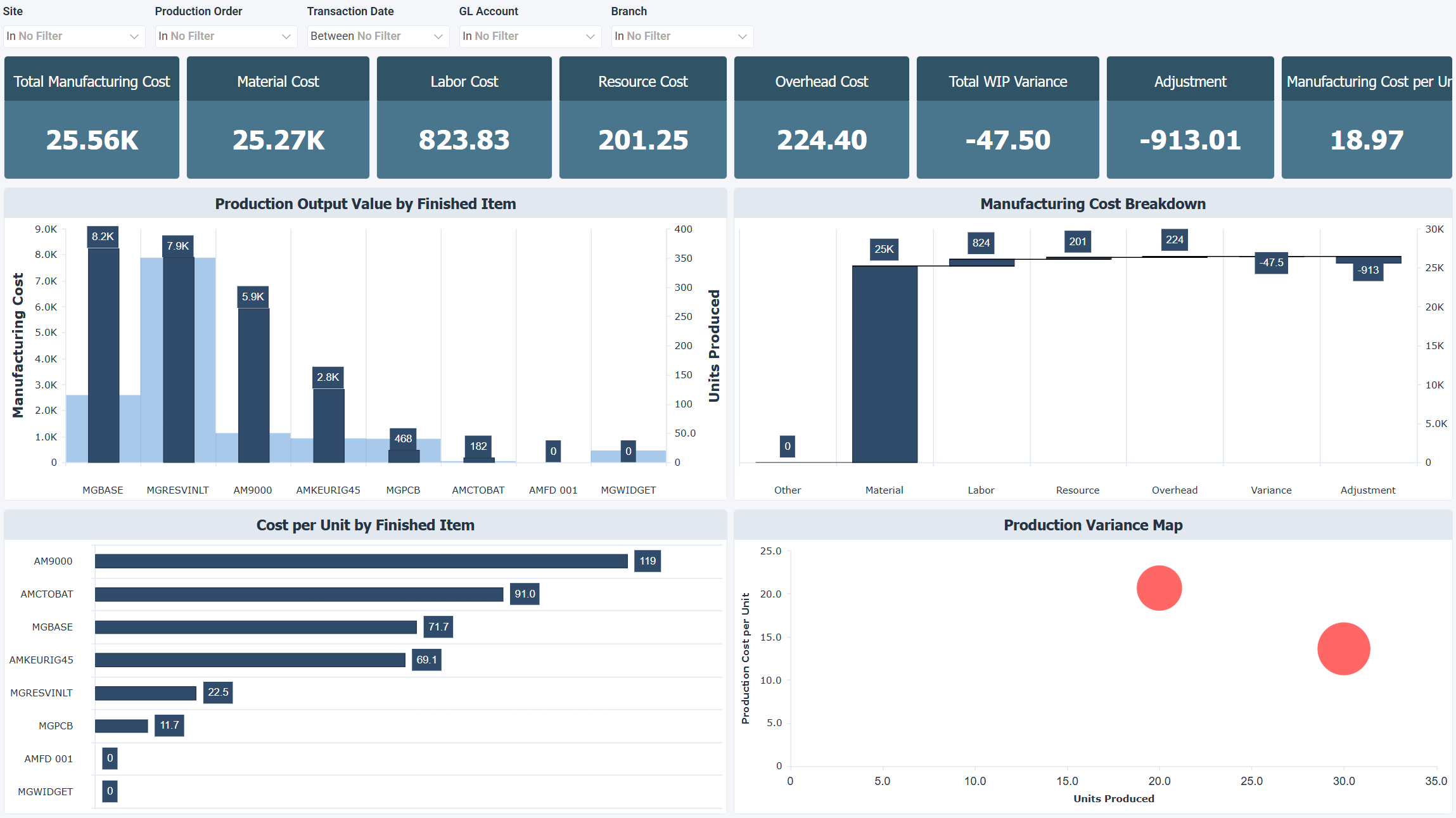
When reviewing this dashboard, material cost is typically the dominant driver of total production cost and often where the most significant optimization opportunities exist. A negative Total WIP Variance means production is currently running below expected cost, which is favorable as long as estimates are accurate. The Production Variance Map is the fastest way to spot outliers, particularly high-volume products with elevated cost per unit that may warrant a process or pricing review.
Benefits of this dashboard
- Understand total production cost and how it is composed across material, labor, resource, and overhead.
- Monitor cost variance to detect when actual costs are diverging from planned estimates.
- Compare cost per unit across products to identify inefficiencies and high-cost items.
- Contextualize cost against production volume to assess overall manufacturing efficiency.
- Identify cost outliers that may require a process or pricing review.
Key performance indicators (KPIs)
Key performance indicators (KPIs) are displayed at the top of the dashboard. They give you an at-a-glance summary of the current cost situation and update based on the filters you apply.
| KPI | Description |
|---|---|
| Total Manufacturing Cost | Total accumulated cost across all production activities, including materials, labor, resources, and overhead. |
| Material Cost | Cost of components and raw materials consumed, typically the largest driver of total production cost. |
| Labor Cost | Total cost of labor applied to production orders. |
| Resource Cost | Total cost associated with machine and resource usage during production. |
| Overhead Cost | Indirect production costs allocated across manufacturing activity. |
| Total WIP Variance | Difference between expected and actual production cost. A negative value is favorable and indicates production is running below planned cost. |
| Adjustment | Manual or system-driven corrections applied to production cost, useful for identifying anomalies and supporting reconciliation. |
| Manufacturing Cost per Unit | Average cost to produce one unit, useful for pricing decisions and margin analysis. |
Visual components
| View | Type | What it shows |
|---|---|---|
| Production Output Value by Finished Item | Combination | Compares manufacturing cost and units produced by finished item, helping contextualize cost relative to production volume. |
| Manufacturing Cost Breakdown | Waterfall | Shows how total production cost is built step by step across material, labor, resource, overhead, variance, and adjustments. |
| Cost per Unit by Finished Item | Horizontal Bar | Ranks finished items by average cost per unit, making it easy to identify high-cost products and cost inconsistencies across the product range. |
| Production Variance Map | Bubble | Plots each production order by units produced (X-axis) against cost per unit (Y-axis), with bubble size reflecting WIP variance. Orders in the top-right quadrant combine high volume and high cost per unit and represent the greatest cost concern. The further right and higher up an order sits, the greater the impact. |
Example dashboard
Filters
Use the filtering panel at the top of the dashboard to control which data is shown. The filters apply to all views and ensure the dashboard reflects the selections you choose.
- Company
- Site
- Production Order
- Work Center
- Labor Code
- Labor Type