Inventory Replenishment & PO Creation
The Inventory Replenishment & PO Creation Writeback template reviews inventory availability and creates purchase orders in Acumatica directly from a workbook. Use it for low stock replenishment, warehouse restocking, suggested order review, and bulk purchase order creation. It uses the NECWRITEBACK formula, generated with the Writeback Wizard, to send changes from your workbook back to Acumatica.
Select Initialize before editing the replenishment grid. This creates a separate workbook copy with static data, so your work isn't lost on refresh.
Typical workflow
- Complete the required header fields.
- Use the optional inventory filters to narrow the eligible items displayed in the grid.
- Select Initialize to create a working copy of the template.
- Review on hand, available, on PO, minimum, maximum, and suggested order quantities.
- Enter an Order Qty for each item to include in the purchase order.
- Review the unit cost, requested date, promised date, tax category, and line status for each selected item.
- Review the validation summary, correct any blocking errors, and confirm that vendor warnings are intentional.
- Select Push to Acumatica to create the purchase order.
- After a successful writeback, use the populated purchase order number to open the document in Acumatica.
- Select Reset before preparing another purchase order.
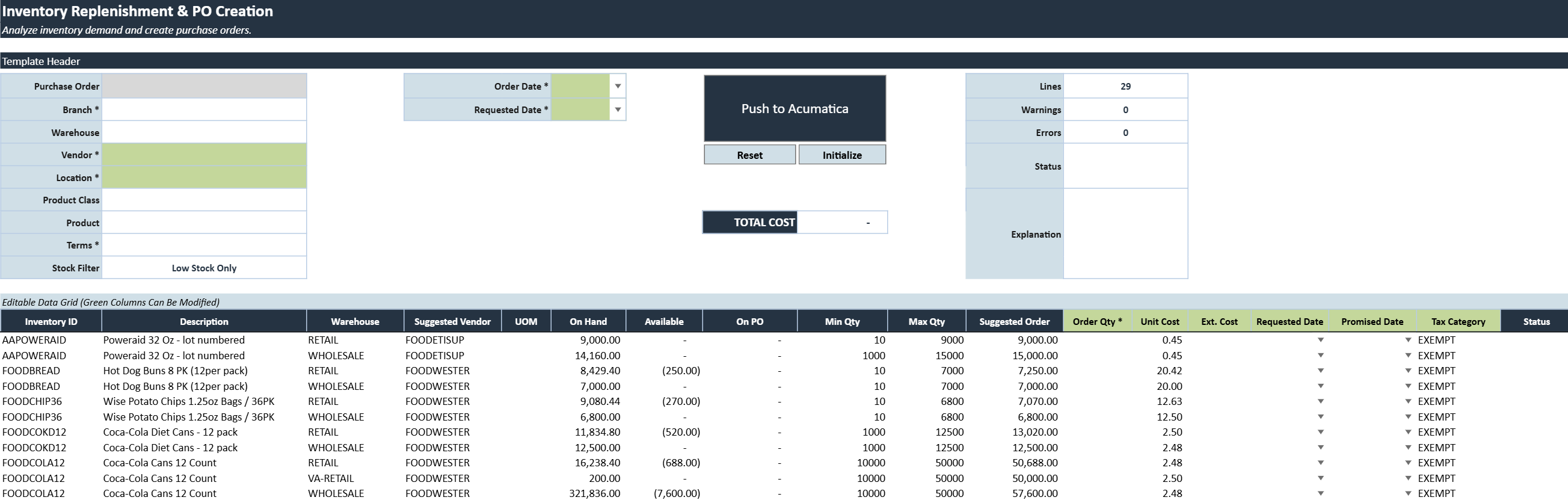
Template header
Defines the purchase order and provides filters used to control the inventory records displayed in the grid.
| Field | What to select |
|---|---|
| Purchase Order | Purchase order number returned by Acumatica after a successful writeback. The populated value links to the created purchase order. |
| Branch * | Branch for which the purchase order is created. |
| Warehouse | Optional warehouse filter used to narrow the inventory records displayed. |
| Vendor * | Vendor assigned to the purchase order. Lines whose suggested vendor differs from this vendor are identified with a warning. |
| Location * | Vendor location assigned to the purchase order. |
| Product Class | Optional filter used to display inventory items from a specific product class. |
| Product | Optional filter used to display a specific inventory item. |
| Terms * | Payment terms applied to the purchase order. |
| Stock Filter | Controls which inventory records are displayed, such as showing low stock items only. |
| Order Date | Date assigned to the purchase order. If left blank, Acumatica defaults the date during writeback. |
| Requested Date | Default requested receipt date for the purchase order. If left blank, Acumatica defaults the date during writeback. |
Vendor applies to the purchase order but does not filter the item list to only that vendor's suggested items.
Writeback actions
| Action | What it does |
|---|---|
| Push to Acumatica | Validates the selected order lines and creates the purchase order in Acumatica. A confirmation message indicates whether the writeback succeeded. |
| Initialize | Creates a separate workbook copy with (Initialized) added to the file name. Data extractions are disabled and the extracted inventory data is made static in this copy so it remains available while order quantities are being prepared. |
| Reset | Clears the current changes and restores the template to its last saved state. Any unsaved order quantities or edits are removed. |
Inventory planning grid
Displays current stock information and contains the values used to build the purchase order. Columns shaded green are intended for user input.
| Column | What it shows |
|---|---|
| Inventory ID | Inventory item available for replenishment. |
| Description | Description of the inventory item. |
| Warehouse | Warehouse associated with the displayed inventory balance. |
| Suggested Vendor | Preferred or suggested vendor configured for the inventory item. |
| UOM | Purchase unit of measure used for the order line. |
| On Hand | Quantity physically on hand at the warehouse. |
| Available | Quantity currently available after considering allocations and demand. |
| On PO | Quantity already included on open purchase orders. |
| Min Qty | Minimum stock quantity configured for the item and warehouse. |
| Max Qty | Maximum stock quantity configured for the item and warehouse. |
| Suggested Order | Suggested replenishment quantity based on current inventory and configured stock levels. |
| Order Qty * | Quantity to purchase. Lines with a value greater than zero are included in the writeback. Only lines greater than zero are included in the purchase order. |
| Unit Cost | Unit cost used for the purchase order line. |
| Ext. Cost | Calculated extended cost based on Order Qty × Unit Cost. |
| Requested Date | Requested receipt date for the individual line. |
| Promised Date | Vendor promised receipt date for the individual line. |
| Tax Category | Tax category applied to the purchase order line. |
| Status | Displays whether the line is ready, contains a blocking error, or requires review. |
Review
Before writing back the purchase order:
- Confirm that the required header fields are complete, including Branch, Vendor, Location, and Terms.
- Check the Lines count to confirm the expected number of items are included.
- Review any Warnings, such as items whose suggested vendor differs from the selected purchase order vendor.
- Resolve any blocking Errors before writeback.
- Confirm the Status shows the purchase order is ready.
- Review the Total Cost for the purchase order.
A vendor warning does not prevent writeback, but confirm that purchasing the item from the selected vendor is intentional. Blocking errors must be corrected before the purchase order can be created.